
2023 in brief
When we look back on the year, we tend to think in milestones. And 2023 certainly had its share: the grand finale of the GIVE project and the launch of the revamped hetarchief.be, to name just a couple. But the real strength of 2023 wasn’t just in the big events – every figure in this report is just one link in a long chain of efforts. And behind every result are real experiences. That’s why – in this annual report – we not only highlight the facts but also ask some of our content partners to share their stories. We hope you enjoy reading it!
Summary
At meemoo, we’re all about the digital archive, but what that actually means isn’t easy to sum up in just a few words. In short, we provide services to our content partners – Flemish cultural, media and government organisations – and the wider sector, and the general public can also count on us. With support from the Flemish government, we carry out the following core tasks. Click through to discover what that entailed in 2023.

Digitisation, digital preservation and management
The archives of our content partners in culture, media and government are packed with testimonies from yesterday and today. To future-proof this material, we help them digitise and digitally archive their collections. Here’s how we did that in 2023:
Safeguarding images and audio
When it comes to our content partners’ audiovisual material, the major digitisation efforts are behind us. By the end of last year, since 2014, we had digitally converted around 544,000 audiovisual carriers such as tapes, cassettes and reels. That’s 85% of the total number of carriers we’re currently aware of.

Our content partners are continuing to acquire new material, of course, and we also occasionally welcome new content partners into our network. To give their material a digital second life, we introduced combo-digitisation – in which we handle a mix of carrier formats in smaller sub-projects. In 2023, we safeguarded 1,139 carriers in 13 different video formats and also worked with 8 audio formats.
We have been collaborating with CINEMATEK to register our content partners’ film collections for years. By the end of 2023, they had registered 17,067 films.Any damaged copies are prioritised for digitisation, and we digitally safeguarded 1,181 of them in 2023.Together with our content partners, we also devised an approach last year for prioritising the digitisation of non-threatened films.
Future-proofing art and heritage
Digitising audiovisual material is in our DNA, but we’ve also been targeting other types of heritage for a few years now. For artinflanders.be, we create high-quality photographic images of art and heritage objects – capturing on film 712 works from 15 Flemish museums and heritage institutions, and photographing thirty masterpieces for the ‘Rare and Indispensable’ exhibition in 2023.
Thanks to additional project funding from the Flemish government and the European Regional Development Fund (ERDF), we’ve been able to accelerate the mass digitisation of Flemish heritage since 2021. In the Coordinated Initiative for Flemish Heritage Digitisation (Gecoördineerd Initiatief voor Vlaamse Erfgoeddigitalisering - GIVE for short), we focused on digitising a large number of masterpieces, newspapers and glass plates. And we were very well supported with help from over 175 partners. Together, we tackled 3D digitisation (link in Dutch) and delved into artificial intelligence – but more on that later.
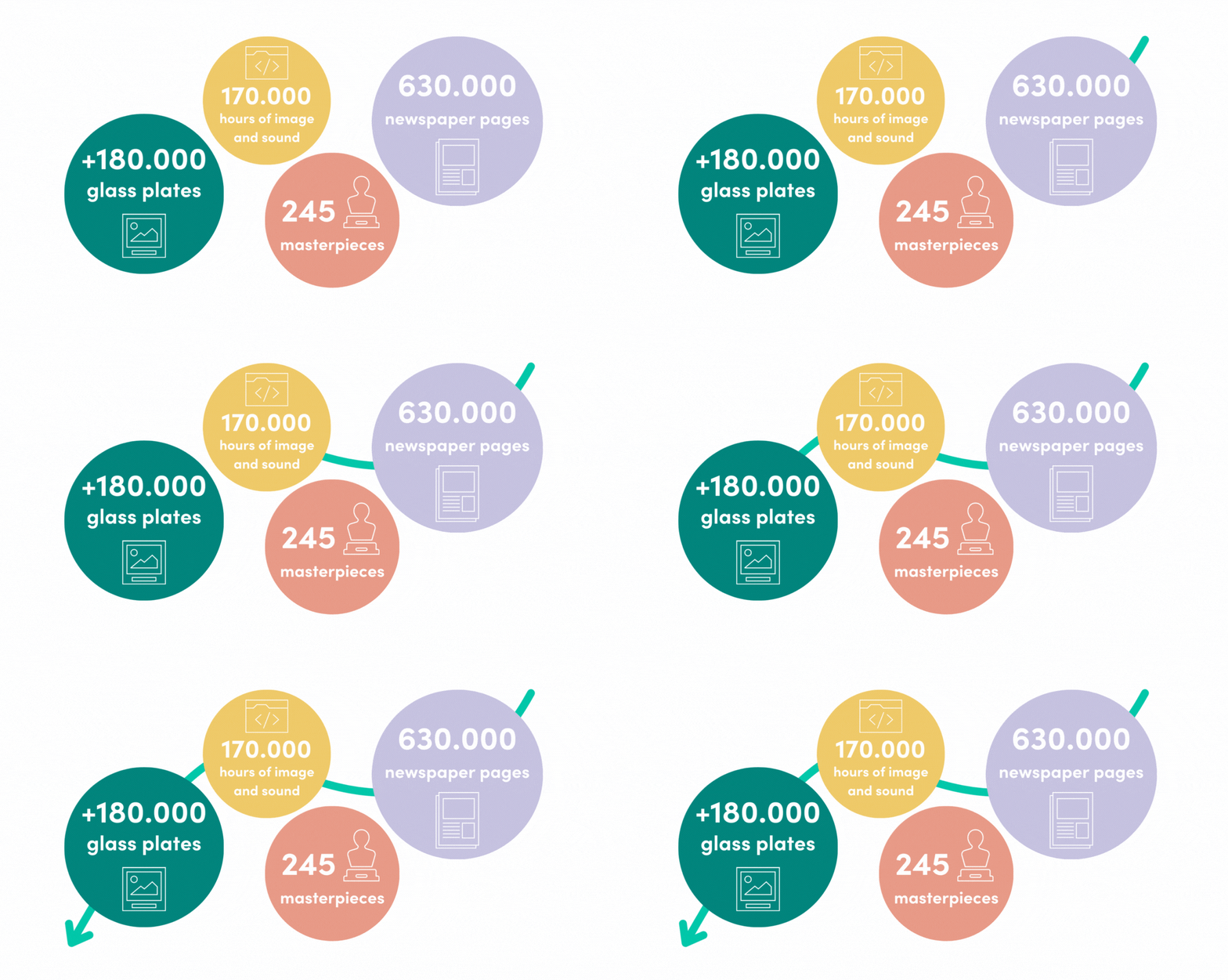
Three years and mountains of work later, by the end of 2023, more than 800,000 heritage gems had a digital counterpart. And this didn’t go unnoticed! We celebrated the end of GIVE with a festive showcase, launching a campaign website and winning three awards. To sample some of the results and enjoy the stories behind the project, visit totindetail.be.
Content partner spotlight: Stadsarchief Brugge (Bruges city archive)
If another opportunity like this presents itself, we’d definitely do it again
At Bruges City Archives, they’ve been focusing on digitisation for years, mainly for access via Beeldbank Brugge and Archiefbank Brugge (links in Dutch). But there is a cost involved, so choices have to be made. When Annelies Mattheus, digital archivist at Bruges City Archives, heard about the GIVE project, she knew she couldn’t pass up the opportunity.
‘It’s a huge relief that a masterpiece and 5,207 glass plates from our collection have now been digitised and sustainably preserved at meemoo thanks to this project.’

Glass plate © City Archives Bruges.
Sustainable preservation
We store all these digitised objects for our content partners in the meemoo archive system – and we added over 1 million objects in 2023, totalling 2.5 petabytes (PB). By the end of 2023, our digital archive held 25.8 PB, or 7.6 million objects.

This growth is no longer solely due to our digitisation projects. In 2023, nearly 860,000 objects entered our digital archive via digital intake. This ensures the sustainable preservation of born-digital or previously digitised material from our content partners.
To meet the high demand for digital intake, we worked on a new tool in 2023 to streamline the intake of small quantities. We tested it with the digitised artworks from the GIVE project.
We also made some infrastructure adjustments to ensure the smooth running of our archive system. Additionally, we continued our storage migration to tapes with larger storage capacity.
Content partner spotlight: The Flemish Department of Culture, Youth and Media
We were really looking forward to it because lots of images were in vulnerable locations
In 2023, we helped content partner the Flemish Department of Culture, Youth and Media to get started with digital intake. Nele Leroy, Collection Manager of the Flemish Community Collection, explains why this was so important to them: ‘We’ve been working on getting our image management in order for a while because many of the images in our collection were in vulnerable locations, such as on hard drives. So we were very keen on starting a digital intake process, with a view to sustainable preservation.’

Maria Lactans, by Brioloto de Balneo, Collection Flemish Community, photo Cedric Verhelst, artinflanders.be, license: public domain.
Making digital heritage accessible
We digitised and preserved a lot of archive material in 2023, but the process doesn’t stop there. Together with our content partners, we want to encourage the reuse of the material archived with us in all its forms. That’s why we make it as accessible as possible for various target groups.
Here’s how we helped users in 2023:
First major step towards a comprehensive hetarchief.be
2023 was the year we finally launched the revamped version of hetarchief.be. The general public could already use that platform to search descriptions of over 1 million image and audio clips from the archives of more than 100 content partners on the platform.
Since last year, searching has become even easier and requesting clips is more streamlined. Users can now also visit a selection of content partners via hetarchief.be (link in Dutch) to consult their material on-site. And there are additional possibilities for content partners, too. So they no longer need to visit the old Catalogus Pro to play their own or fellow content partners’ material; now they can do it directly on hetarchief.be. This improves the platform as a starting point for research and creates an ideal bridge to our partners’ collections.

And there’s more to come. In the future, newspapers and images of art and heritage objects will also be available on hetarchief.be – and we started preparations for this in 2023. We also made progress with preliminary research into the possibilities of a professional exchange platform for audiovisual material in Flanders (and this will continue in the new Hermes project, where we aim to stimulate media reuse).
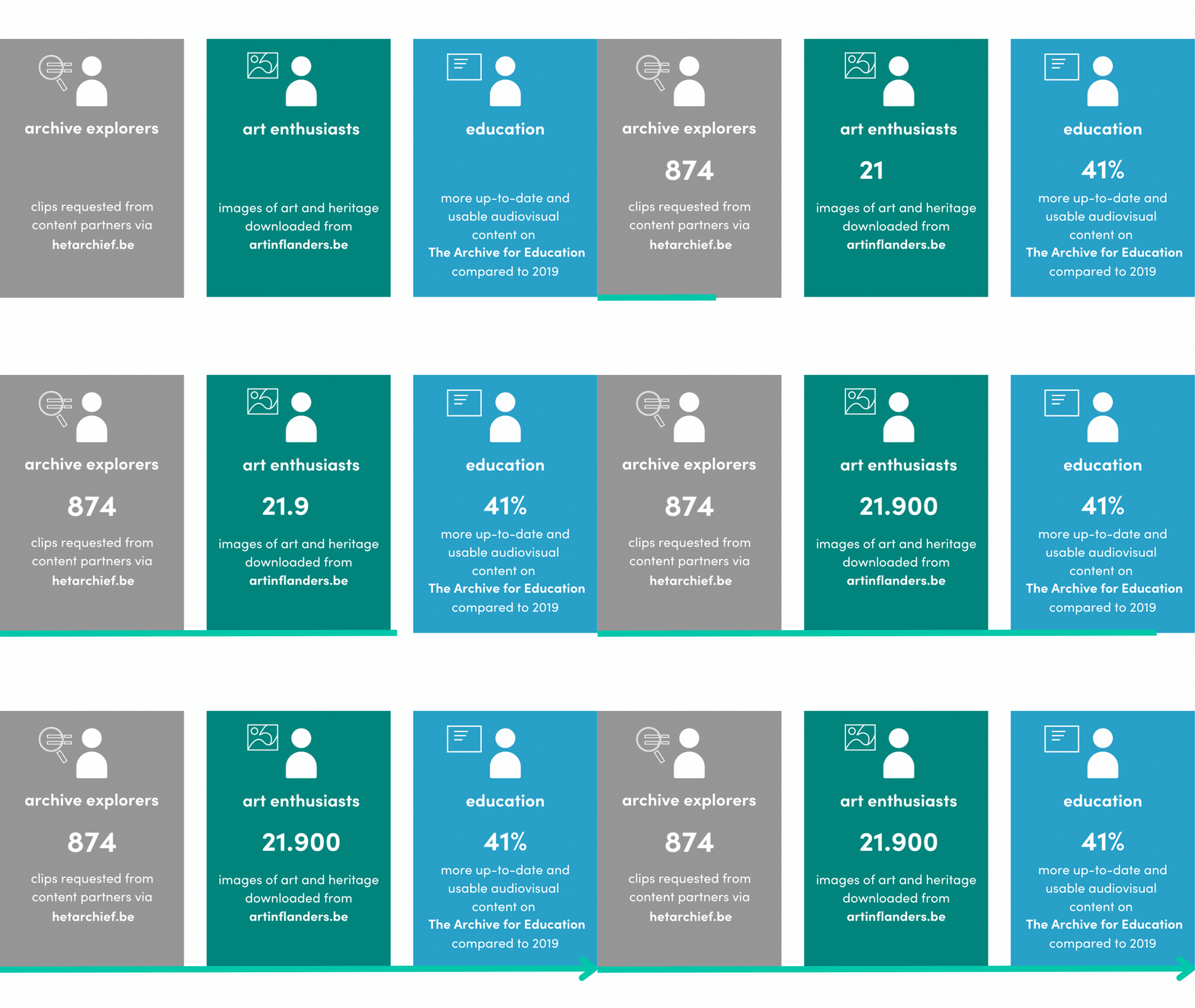
For now, art lovers can still visit artinflanders.be where they can admire high-quality images of art and heritage objects from over 100 Flemish collections and, in many cases, download them for free. And in 2023, they did so enthusiastically: we counted exactly 21,900 downloads – over a third more than the previous year.
Content partner spotlight: ADVN (Archive for National Movements)
Until recently, we didn’t have an audiovisual catalogue available for visitors
By the end of 2023, nine content partners were using the visitor tool (link in Dutch) on hetarchief.be – allowing them to let visitors on site consult audiovisual material preserved at meemoo. Content partner ADVN was actively involved in the launch and the first to use the tool.
Sophie Gyselinck, public affairs officer at ADVN, explains: ‘We were already involved in the preliminary research that resulted in the visitor tool, and then we also took part in the pilot project.’
How did it go?

The Archive for Education
With The Archive for Education, we help teachers and trainee teachers with audiovisual material for the classroom. Secondary school students have also been welcome on the platform since 2022: teachers can set them to work with engaging audiovisual assignments. And in 2023, we highlighted these new possibilities with impressive results. By the end of the year, we had already counted over 31,000 assignments created on the platform.
And new at the start of the 2023-2024 school year were the collaboration options for teachers on The Archive for Education. Due to high demand, they can now work together on collections and assignments, and exchange teaching materials. This was made possible thanks to Digisprong funding, as well as a more user-friendly login on the platform.
The offerings on our education platform grow year by year: by the end of 2023, the image database contained over 26,800 image and audio clips from the archives of 60 different content partners. Our editorial team also built many new collections tailored to primary and secondary education. For example, we responded to current events – such as the Canon of Flanders – and collaborated with partners like FARO, VIVES University College, Mediawijs, the Special Committee for Remembrance Education, VRT and KANTL.
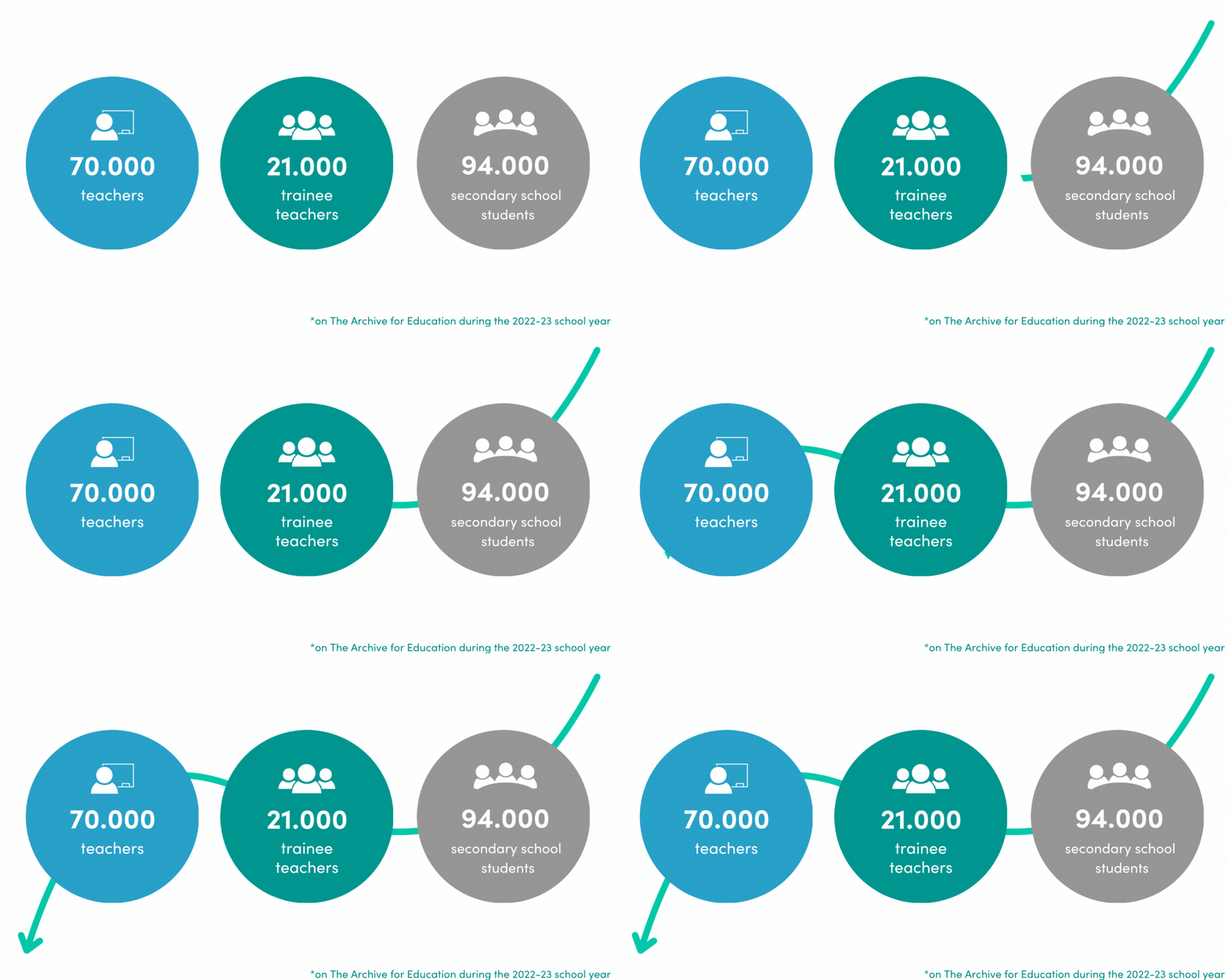
All this led to a lot of traffic on The Archive for Education platform in 2023. Compared to 2019, we noted a 100% increase in primary school teachers with an account on the platform in 2023, and 47% more secondary school teachers. To guide them on The Archive for Education, we organised 68 workshops. By the end of the 2022-2023 school year, over 94,000 secondary school students had also found their way to the platform.
Accessible thanks to IIIF
To manage, exchange and unlock digital images and metadata on the web, we also focused on IIIF in 2023. This International Image Interoperability Framework allows you to admire a selection of results from the GIVE project in detail on totindetail.be. And to inform the sector about the possibilities of this open set of standards, we organised two ‘IIIF Fridays’ together with the Public Library of Bruges, Ghent University Library and the former Flemish Art Collection. We also completed the final phase of the project to develop a IIIF image infrastructure for the VKC ecosystem and prepared IIIF services for our content partners.
Gathering and sharing knowledge, and giving advice
When there’s knowledge to be gained about digital heritage processes, we’re quick to act. Not only to use in our own operations but also to experiment with in projects and help our network move forward. In 2023, among other things, we did this by:
answering 313 requests for advice from 164 enquirers from the broader cultural heritage sector;
collaborating on 10 subsidised projects with other cultural organisations, more on which below;
concluding the supervision of 27 projects for dealing with the backlog of digital collection data after 3 years;
supporting content partners and organisations from the cultural field with numerous training sessions and events.
We also made the final sprint towards a unified knowledge database, aiming to launch it in 2024. As well as combining the knowledge from projectcest.be, meemoo.be and vlaamsekunstcollectie.be, the cultural heritage sector is also invited to share insights there.
We collected and shared knowledge in 2023 with the following five domains in mind:
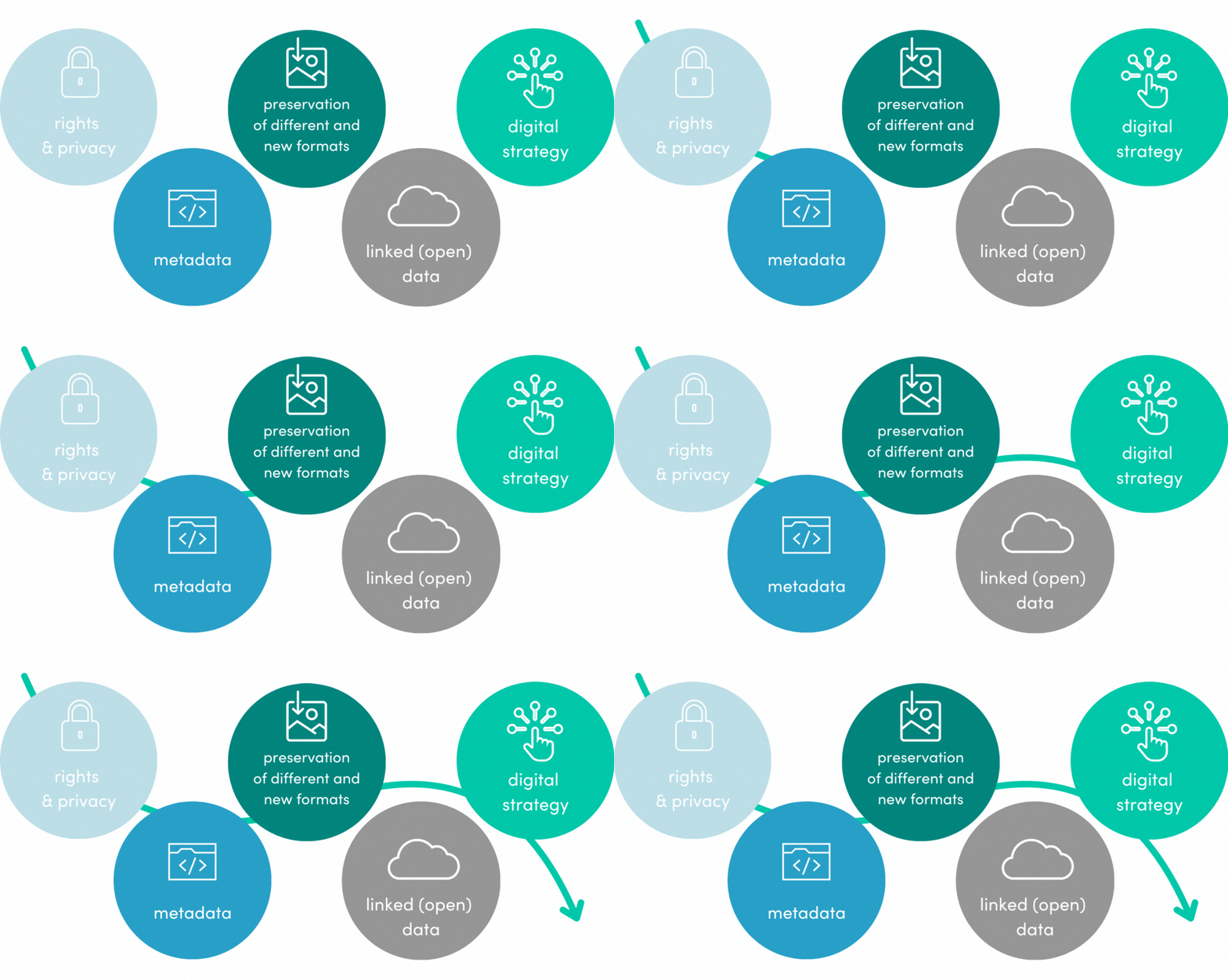
1) Metadata
Metadata is a cornerstone of our operations – not only for managing and making our content partners’ material accessible, but also for our internal processes and services to partners and the broader cultural sector. We could go on endlessly about this, but we’ll limit ourselves to a few highlights:
Managing metadata
In 2022, on the way to improved metadata management, we acquired a new metadata infrastructure. In 2023, we started configuring it and used the software for the first time. So what will be first major use case that uses data from the knowledge graph, the core of our new metadata infrastructure? We’ll have to wait a little bit longer for the next phase in revamping hetarchief.be to find out.
We concluded the GIVE metadata project with unprecedented figures: by the end of 2023, we had performed facial recognition on 120,000 hours of video, recognised speech in 170,000 hours of audio, and applied entity recognition to the transcripts that resulted. This yielded thousands of detected faces, words and entities such as people, places and events. All within a correct ethical and legal framework, of course.
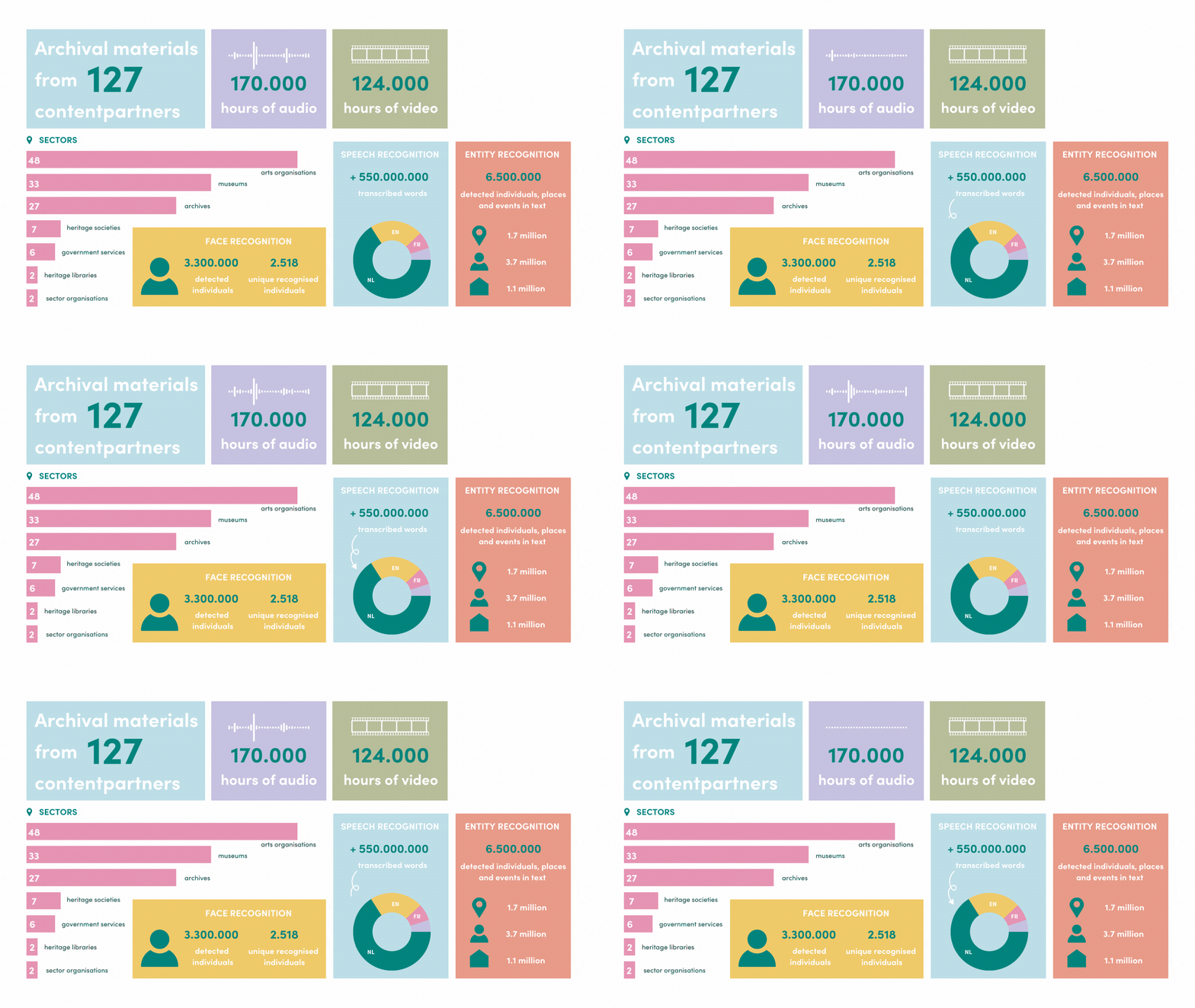
Building on these experiences, the Shared AI project also started in 2023, where we work with our media partners to process their content. And to pave the way for future projects around metadata creation and enrichment, we’ve been supporting the development of a visual list of personal names since last year.
Exchanging metadata
When exchanging metadata, uniformity is crucial. And the Flemish government is aiming to address this with the Open Standards for Linked Organisations (OSLO Cultural Heritage). In 2023, we contributed to improving this standard and its use in the cultural heritage sector by:
participating in the ‘Research into a governance structure for the OSLO standards’ project;
temporarily coordinating the ‘OSLO Cultural Heritage’ working group, together with the Flemish Department of Culture, Youth and Media;
publishing a five-part step-by-step plan and expanding existing documentation (Guide to OSLO, Basic Registration as OSLO, and JSON-LD) (links in Dutch).
Registering metadata
The Objects Entry Book and the Publications Entry Book are there to help registrars register heritage in a structured and standardised way. In 2023, we continued working on these handbooks. The Publications Entry Book was completed and published, and we assembled an editorial board to approve the content.
2) Rights and privacy
When making cultural content accessible, copyright and usage restrictions play a key role. To help organisations tackle these challenges, we previously made some handy tools (link in Dutch) available. In 2023, we provided support on rights by answering numerous helpdesk questions and organising two rights workshops, including one during Public Domain Day (link in Dutch). Together with FARO (Flemish Institution for Cultural Heritage) and the former Flemish Art Collection, we also organised a meeting of the Copyright and Heritage User Group. And what about projects? Rights and privacy played a significant role in DO IT!, social media archiving and Nieuwe Tijdingen, among others.
3) Linked (open) data
To help organisations make their cultural data not only open but also findable, accessible, interoperable and reusable, we organised the 6th edition of the Open Cultural Data Bootcamp (link in Dutch) in 2023. This year, extra attention was given to linking data during a Flemish-Dutch knowledge exchange day in collaboration with the Dutch Digital Heritage Network (NDE).

After three years, the Collections of Ghent project – in which, together with a lot of partners, we used linked open data to bridge cultural heritage, technology and the residents of Ghent – came to an end in the summer of 2023.
And just after the summer, it was time to celebrate: it was exactly 10 years since we first started focusing on persistent identification. When you want to share information about collections on the web, it’s important to link your data and identify objects persistently (i.e. sustainably) and unambiguously. This prevents link rot. We celebrated this milestone with a study day (link in Dutch)and some new tools to get started with it.
4) Preserving other and new formats
Preserving heritage starts with identifying what material you have. With the identification tool knowyourcarrier.com, you could already figure out what audiovisual material you have hiding in your attic, for example, and learn more about its preservation, digitisation and heritage value. In 2023, this tool also became available for photographic material – thanks to the GIVE project!

Speaking of new formats: in the GIVE project, we experimented with 3D digitisation for the first time. We shared our approach to digitisation, preservation and making 3D models accessible in this tech blog (link in Dutch). Since 2020, it has also been our mission to develop best practices for capturing, archiving and making social media accessible. These platforms are a treasure trove of information about our times, yet they are still under-archived today. The project concluded last year – with a study day as its grand finale – but continues in the Social Media Archiving Practice Network (links in Dutch), which met for the first time in 2023.
5) Digital strategy
How can cultural organisations use digital tools to fulfil their mission? At meemoo, we’re exploring ways to develop digital strategies, and investigating how we can best support organisations in this regard. In 2023, we engaged in the Digital Leadership in the Cultural Sector training programme, and once again partnered with the Flemish government to develop the policy strategy for digital transformation in the cultural sector.
To help cultural organisations with their digital strategy, we also facilitated a session with the Digital Maturity Self-Assessment Tool last year, and organised a workshop on the Digital Sustainability Score Model.
En route to a new heritage database
Last but certainly not least: in 2023, we continued working on a solution for the Erfgoedplus and Erfgoedinzicht heritage databases in close collaboration with current users, the Flemish Department of Culture, Youth and Media, FARO and the former Flemish Art Collection. After the project proposal was approved in 2021, and 2022 was dedicated to analysis, we made a crucial decision in 2023. Instead of two new systems, we are working towards a single collection management system for everyone. We chose software from the Swiss company zetcom as the basis for the new heritage database, and last year was mainly taken up by this procurement process.
Since 2021, meemoo has been providing operational support for Erfgoedplus, and in 2023 we prepared to take over the operation of Erfgoedinzicht from 2024 onwards.

Zooming out
Just before the end of the year, it was announced that the digitisation operations and colleagues from the Flemish Art Collection would join meemoo from 2024, and our management agreement with the Flemish Government for 2024-2025 was given the green light.
In 2023, our accounts recorded a turnover of €9.28 million and costs of €9.27 million. This is significantly more than originally described in the 2019 strategic plan, largely due to additional assignments – such as GIVE and the heritage database – and high inflation over recent years. A major budget item in 2023 was the GIVE project (€1,706,661), as well as personnel (€3,673,428), the archive system infrastructure (€1,163,778) and the digitisation of audiovisual carriers (€657,936)
In the spotlight
Content with our content partners
We would like to thank our content partners, who entrust us with their content, enthusiastically participate in digitisation projects, and store their material with us. In 2023, nine new partners joined, bringing the total to 181 Flemish organisations in the cultural, media and government sectors. We welcomed them to two partner events last year: one online and one at the Hendrik Conscience Building in Brussels. The Flemish Minister of Culture, policymakers, sector colleagues and GIVE project partners joined to celebrate the results of the GIVE project.
The past few years have also been marked by a revision of the collaboration agreement with our content partners. In 2023, we continued discussions with several content partners and the signing process progressed.
Content partner spotlight: Abbey Museum of the Dunes
The complete package from meemoo appealed to us
We have been collaborating with the Abbey Museum of the Dunes for some time as part of artinflanders.be. In 2023, the museum in Koksijde also became a meemoo content partner. Their collection, mainly consisting of archaeological finds and religious heritage, comprises around 100,000 pieces that they want to fully digitise and re-register.
Gianna Hubert, collection manager-registrar, explains.

Gianna Hubert of Abbey Museum of the Dunes, © Abbey Museum of the Dunes.
Nothing but praise for our meemoo people
In 2023, it was impressive to see how around 60 permanent team members, seconded teachers and interns brought the past to life again, each from their own expertise.
Thank you for your dedication. We’re extremely grateful! During a team day at the end of the year, we shared plans for 2024 and celebrated each team.


So, that was our year. Or at least a part of it, because all that dedication simply can’t be captured in just 3,000 words. For the daily nuances and a behind-the-scenes look, follow us on our socials. Or subscribe to our newsletter (in Dutch) if you’d prefer to receive more concise updates from time to time.


