
Green light for our multi-year plan: what we have in store for 2026-2030
31 Jan 2026In 2025, we celebrated five years of meemoo. Now, we’re looking ahead to the next five. Just before the end of the year, the Flemish Government gave the go-ahead for our management agreement for 2026-2030. Over the next five years, we’ll be working with a new policy plan in a changed budgetary context. What does this mean in practice? Read on.
This approval provides direction, responsibility and trust. At the same time, it has forced us to make some tough choices: we will have to manage with 7.5% less in terms of resources in the coming years. In addition to a reduction in our structural operating budget, the subsidy for The Archive for Education from the Education Department is discontinued in 2026. With adjusted ambitions but the same drive, we are fully committed to further building and sharing Flanders’ digital memory with our partners in the coming years.
Update February 2026
In February 2026, we were informed that from 2027, there will be a further 5.25% cut in funding – bringing the total reduction for meemoo to nearly 13%. This changed budgetary context will impact our operations and services. In spring 2026, we will take time to revise our plans. Please note that the plan you can read below only accounts for the initial 7.5% cut and is therefore still subject to change.
What to expect from us in the next five years
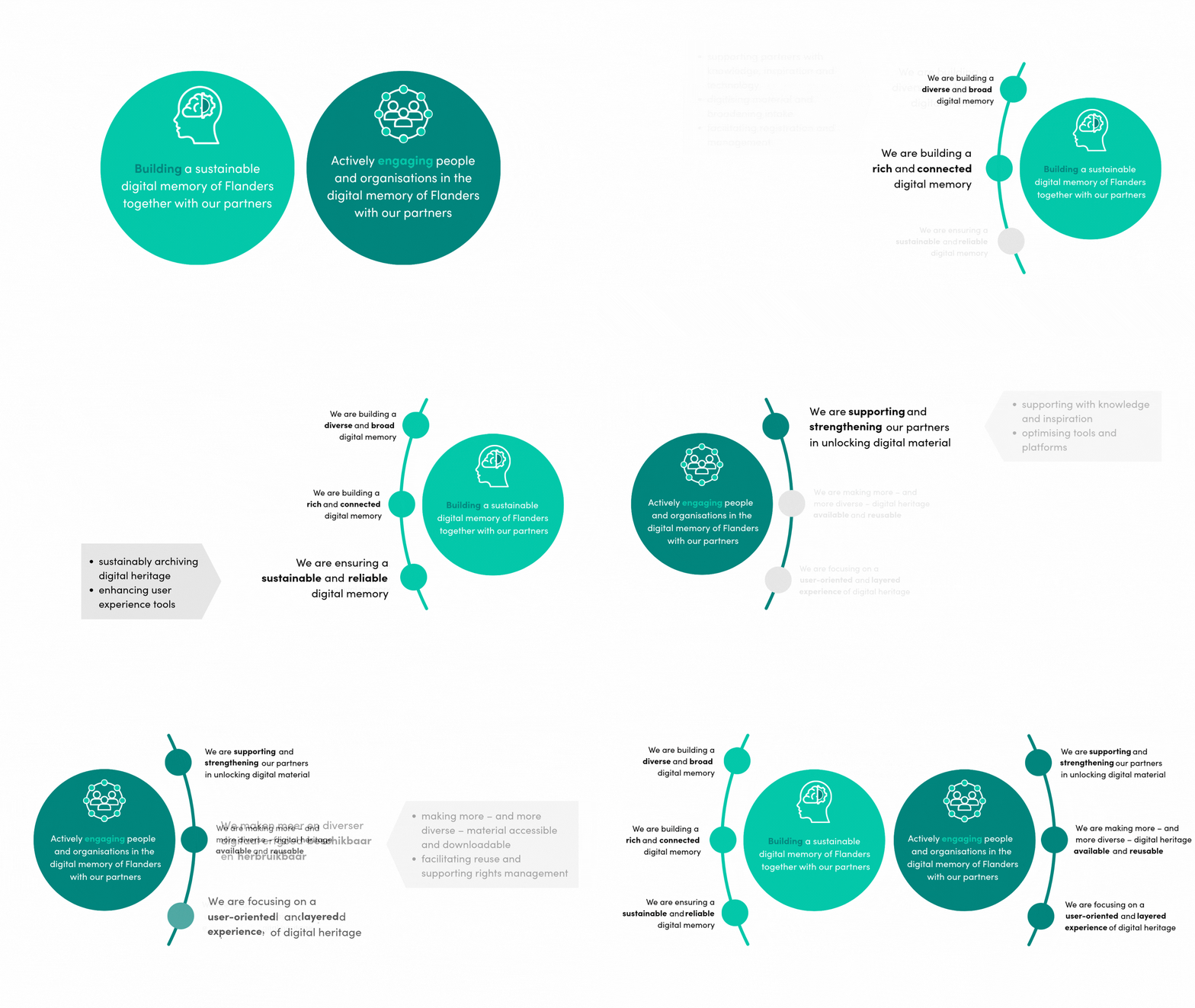
By building a diverse and broad memory, we give space to the many voices, stories and forms of heritage that Flanders is rich in. And we can’t do it alone – it’s the work of many partners.
We empower our partners with knowledge, inspiration and technology. We share expertise on digital heritage processes, enable knowledge exchange with others, highlight challenges and opportunities (e.g. AI) and help make insights measurable.
A broad digital memory means preserving more vulnerable heritage digitally. Over the coming years, we will facilitate the intake of digital collections into our archive system, where they are preserved sustainably. We are also welcoming more diverse types of digital material. On the other hand, we are continuing to digitise at-risk audiovisual material and film. And we remain committed to digitising museum collections and masterpieces while exploring the best ways to continue this in the future.
The key to managing and unlocking digital heritage is proper registration. With the heritage database, we unburden a wide range of heritage actors in the registration and management of their collections. In 2026, we will complete the migration of collections from the previous databases and welcome new users. We are continuing to refine the system in close consultation.

A digital memory is more than just storage: it is a network of meaning. We ensure that the data or information about heritage is not isolated but interconnected – making it more findable and usable for our partners and beyond.
In the coming years, we will work on more and better metadata. In the past, we have enriched thousands of hours of audio and video in the meemoo archive system using AI. We are now making this possible for new material that flows in, and also supporting organisations in the creation of high-quality and uniform metadata. We will continue to refine the Entry Books with clear guidelines for documenting heritage. And to avoid name confusion when describing people, we are further developing a visual personal names list for the cultural sector. We will include this list in a prototype of an overarching Flemish Term Network, more on that here.
We are also improving the possibilities to manage and connect metadata in a broader ecosystem. In recent years, we have built a solid metadata infrastructure, but the significant growth in data brings new demands. We are therefore drawing up a roadmap for the coming years and examining data management – at meemoo, but also more broadly.

A digital memory is only as robust as its foundations. Over the coming years, we will be investing heavily in our infrastructure – so our content partners can rely on us to sustainably and reliably preserve their digital heritage, now and in the future. We are now keeping millions of objects digitally safe in the meemoo archive system. Nothing is lost!
We maintain our storage infrastructure with care and place extra emphasis on security. Our preservation processes are also being continuously refined. By the end of 2030, we are aiming to achieve the Trusted Digital Repository Core certificate: an international recognition of reliability, accessibility and sustainability. We will also complete a major storage migration: the switch to a new file format and tapes with larger storage capacity. Furthermore, we are using our infrastructure to support the AIDA collaboration in the sustainable preservation of digital private archives.
In recent years, our services, platforms and tools have grown significantly. By linking the different systems, we are making our infrastructure more accessible to use. We ensure integration between the heritage database and the meemoo archive system, and the VKC tools and platforms (which have been under our wing since 2024) are also being addressed.

We not only want to build the digital memory but also actively involve people and organisations in it – because a hidden memory remains unused. And that’s why we help our partners make their digital heritage (even more) visible and usable.
We support our partners with knowledge and inspiration in sharing digital heritage. They can rely on us for advice and training on topics such as copyright, innovative forms of access (think IIIF and extended reality), and the possibilities of Wikimedia platforms. And we bring them together to exchange knowledge, as there is much to learn from each other.
Making digital heritage accessible must also be feasible –vtechnically and financially. We want to make it easier for our partners, for example by providing technical links that allow them to display the objects we preserve for them on their own channels. And we’re continuing to offer ready-made solutions to make digital material accessible – at partners’ locations (via the visitor tool) and on the erfgoeddatabank.be collection website.

We also make our partners’ digital heritage available through our own platforms – on a large scale, and across organisations. This increases the chance that their material will be reused – in research, education and new creations.
We already make historical newspapers, art and heritage objects, and (the metadata about) audiovisual archive material available to the public through various channels. In the coming years, we want to further adapt our platforms to make more – and more diverse – material accessible. More heritage on erfgoeddatabank.be, extra newspapers on thearchives.be, and perhaps later also photographic material – but we will first investigate this over the coming years.
We not only increase the visibility of our partners’ digital heritage through our platforms, but also encourage reuse. In the coming years, we will make more material in the public domain available as free downloads. And we are building smoother exchange possibilities for our content partners, who can view each other’s material via thearchives.be.
There is a lot to consider when making this material reusable – because what can and can’t you do with it? By lowering thresholds, we supportour partners in reuse and rights management. We build clear frameworks, create awareness about rights information, and implement the new rights model in our own operations.

Digital participation starts with a good user experience. By focusing on diversity and user-friendliness, we make heritage meaningful for everyone who visits our platforms – from researchers to students, and from artists to heritage enthusiasts.
Over the coming years, we will improve the search experience and findability of material on our platforms. We’re exploring how users can search across platforms, so they can easily find heritage – regardless of their starting point. We help people find their way faster with extra descriptions, smarter search techniques, and attention to search engines and the changing search reality.
Learning, discovering or inspiring? Not everyone uses digital heritage in the same way – and that’s why we’re focusing on our platforms’ user-friendliness tailored to different types of use. Today art lovers can visit artinflanders.be and flemishartcollection.be, but in the future we will provide an art experience on one integrated platform.
Access to audiovisual archive material is invaluable for education. With The Archive for Education, we are continuing to make the rich digital memory usable and deployable in the classroom.The limited budgetary framework is felt here – the focus will mainly be on user support, a high-quality and easily usable platform, and an offering that breathes cultural education and media literacy.

What guides our work
Whatever we build or share, we always carry a few core values with us. We are continuing to work on ethics and sustainability, international exchange, a professional and warm partnership, and our colleagues’ well-being.

Partnership, stakeholders and service offering
Building and sharing the digital memory is not something we do alone. Our collaboration with a wide range of partners runs like a thread through everything we do. In the coming years, we will strengthen this collaboration by further focusing on communication and reporting. We are also evaluating and adjusting our consultation and participation model where necessary – and renewing our partner and service model into a more coherent whole.
Internationalisation
Our collaboration doesn’t stop at the national borders. We are strengthening our impact beyond Flanders by exchanging knowledge internationally, contributing to innovative practices and attracting additional resources. We do this by engaging in European projects, being active in knowledge networks and setting up international exchanges. For example, we are aiming to bring the No Time To Wait conference to Flanders in 2028.
Ethics and sustainability
Moreover, we view everything we do through an ethical and sustainable lens. In the coming policy period, we will emphasise its importance even more within our operations. We are building a practical ethical framework, for example in the use of AI or the creation of content, and are working on an internal approach to sustainability in the broadest sense – from ecological impact to safety.
Organisation and personnel
Our dedicated meemoo team ensures that the words in this plan become reality. We support colleagues in their roles and growth by investing in training, knowledge sharing and inspiration. We are additionally rolling out a participatory organisational trajectory to improve not only the well-being of our employees but also the quality of our services.
With thanks to the Flemish Government, and in particular Minister Caroline Gennez and the Department of Culture, Youth and Media, for their trust. And with much appreciation for our partners and meemoo colleagues who work on this every day.
Images
Turnerin, Heinrich Hamann, collection Museum of Arts and Crafts, Hamburg, Duitsland, CC0, via Europeana
Joop van Bilsen voor Anefo, CC0, via Wikimedia Commons
Nationaal Archief, CC0, via Wikimedia Commons
Swedish National Museum of Science and Technology, Sweden, public domain, via Europeana
Willem van de Poll, CC0, via Wikimedia Commons
Anefo, CC0, via Wikimedia Commons