
2025 in brief
In many ways, 2025 was a year of celebration – we blew out five candles, launched a brand-new heritage database, supported a larger network than ever before and brought a wealth of historic newspapers into the public eye. At the same time, it was also a year of reflection and consultation. We successfully concluded the 2024-2025 management agreement and laid the groundwork for a sustainable story in the years ahead.
Back to 2025: digital safeguarding of heritage on the rise
Moving images and audio
Our digitisation efforts go back to before we were meemoo. By the end of 2025, we had digitally preserved nearly 90% of the Flemish audiovisual heritage known to us. But there’s still plenty to more to do. We’re still pooling audiovisual materials across partners through smaller digitisation projects – a win for both scale and efficiency.
Last year, we launched the third combo project, starring VHS cassettes. The outcome: by the end of 2025, we had digitised 6,222 of these video cassettes for 45 content partners. Behind the scenes, we also implemented a new system to track registration and digitisation processes even more efficiently.
Art and heritage captured in sharp focus
In 2025, art and heritage objects also came into crystal-clear view – quite literally. We captured high-quality photographs of 570 artworks and heritage objects across nine partners. We also created digital 3D copies of 105 pieces, scanned from head to toe.
Preserving and managing on an ever-larger scale
Digitising is one thing, but ensuring that files remain readable and usable in 10, 20 or even 50 years’ time is just as crucial. Every bit belonging to our partners is safely stored in our digital archive system – now and for the future.
In 2025, the digital memory grew substantially again. Over half a million digital heritage objects from our partners flowed into our meemoo archive system – adding 2.2 petabytes (PB) of data in a single year, and taking our archive beyond the 30 petabyte threshold for the first time.

Digital intake gains momentum
Most materials come to us digitally nowadays. Since late 2025, this has been facilitated by an improved workflow and a new tool – making it easier for partners to submit digital content for long-term preservation.
At the same time, we’ve further mapped out our partners’ digital collections. What files are still on the shelves? And what do they require to be preserved for the long term? To ensure we can meet archival needs well into the future, we’ve devised a preservation plan that sets out key processes, preferred formats and different levels of preservation.
Smoke without fire
To accommodate the growth of our digital archive, over the past few years we have been gradually migrating data to high-capacity tapes with more storage capacity. By the end of 2025, more than half the archive had been successfully migrated.
In September, a smoke incident at one of our storage sites temporarily disrupted operations. The equipment that reads and writes our tapes was damaged, but thanks to the availability of our secondary data centre and the dedication of our team, our partners hardly noticed a thing. This is exactly why we invest so heavily in sustainable preservation – we keep multiple copies of every object across several locations to ensure our partners’ archival materials remain safe and accessible at all times.
Smarter searching thanks to intelligent metadata
Heritage that can’t be found stays hidden. And that’s why we invest in metadata – the descriptions that explain what an object is, who appears in it and what it’s about. Since manual large-scale description is practically impossible, we’ve been exploring how artificial intelligence (AI) can help, together with our partners.
In 2025, we tested new techniques within the Hermes project. We identified faces in more than 10,000 photos, trained AI to distinguish between speech, music, applause and laughter, and experimented with voice recognition to identify public figures in audiovisual materials.
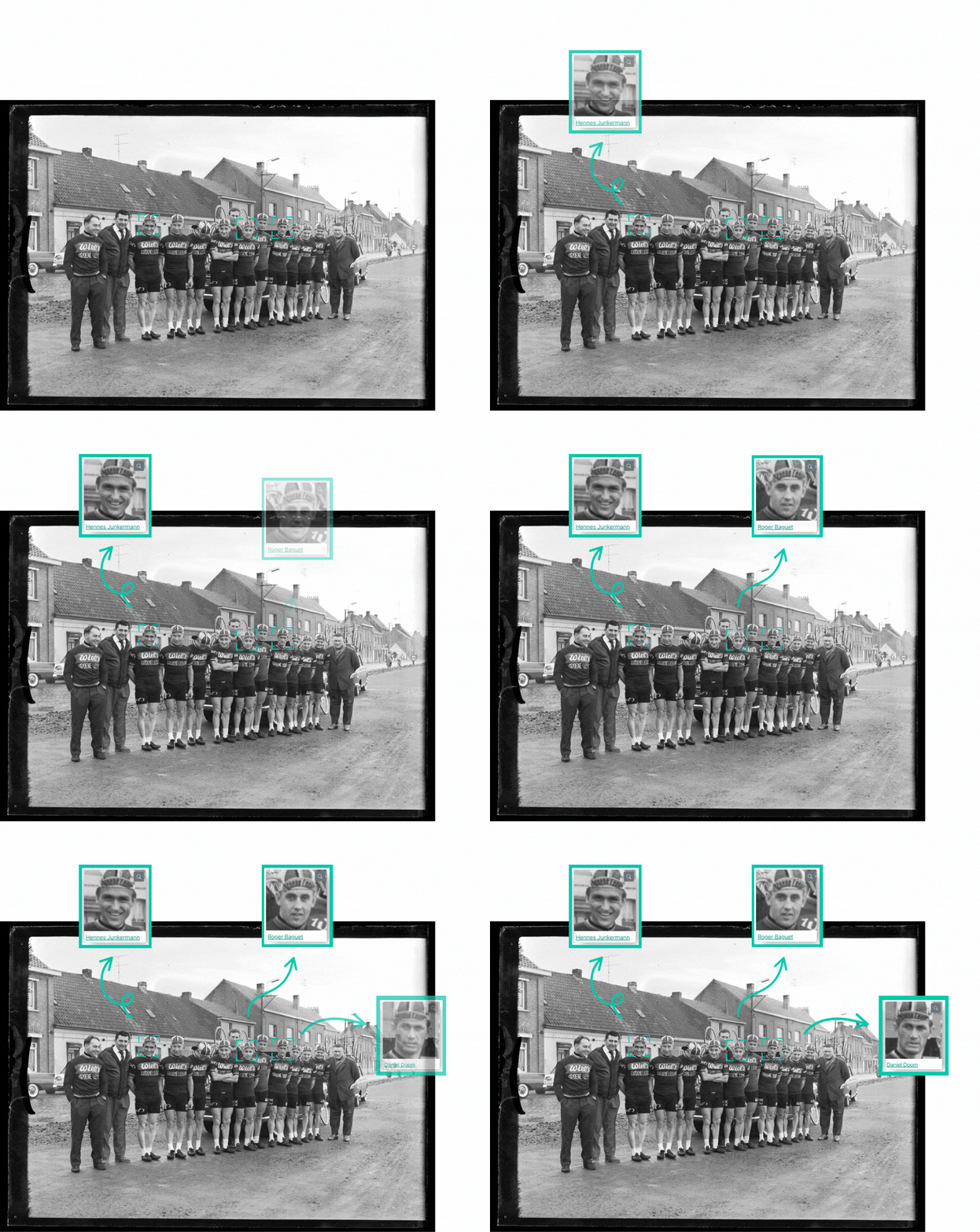
Cycling race, Wiels Groene Leeuw team photo, Amsab Institute for Social History, copyright status unknown
Metadata as a cornerstone: the knowledge graph
Creating metadata is only part of the task. They also need to be managed and interconnected. Last year, behind the scenes, we continued building our knowledge graph – the central structure linking heritage objects with the metadata we hold at meemoo. In 2025, thearchives.be used data from the knowledge graph for the first time. Although invisible to the platform’s visitors, this milestone ensures a smoother exploration of our partners’ digital heritage.
Here it is: the new heritage database
Want to easily register and manage heritage collections? Since 2025, hundreds of organisations have been doing just that thanks to the brand-new heritage database. In March, we launched this new collection management system for the heritage sector – a goal we’d been working towards since 2022. A true milestone! Step by step, collections from the old Erfgoedregister and Erfgoedinzicht platforms are being transferred here. Users of Erfgoedregister and their collections made the leap in 2025 – allowing that platform to retire. We’ve also been working hard to prepare the heritage database for the upcoming Erfgoedinzicht migration – planned for 2026.
And it’s not just a system working behind the scenes –in September, with erfgoeddatabank.be we opened an online window onto collections. Organisations big and small are contributing to a rich and colourful mix of heritage made accessible to all.

From preservation to experience
Heritage truly lives on when people can discover and use it. Together with our partners, we don’t just preserve the digital memory for the future; we also make it visible and accessible today. We support partners in unlocking their collections and making heritage accessible across organisations.
The artworks, heritage objects, newspapers and audiovisual clips on our platforms continue to attract an audience – in 2025, they were consulted at least 2.5 million times by teachers, pupils, researchers and creators, as well as curious visitors keen to delve into the past.
Over one million newspaper pages at your fingertips
What brought this surge of visitors? The arrival of newspapers at thearchives.be. After years of preparation, in August we made an unprecedented treasure trove of press history digitally searchable at thearchives.be – over 180,000 historic newspapers, more than one million pages from the collections of 20 partners, on top of the audio and video clips already searchable on the platform.

Not everything on thearchives.be can be freely viewed or listened to because many of these materials are protected by copyright or related rights. That’s why we developed the visitor tool, which allows people to access protected materials at heritage organisations themselves. An increasing number of organisations are offering access: in 2025, 15 additional providers began using the tool.
Art and flair
At artinflanders.be and flemishartcollection.be, we bring art and heritage from Flemish collections to your screen – to admire, read more about or engage with hands-on. By the end of 2025, visitors could explore over 26,000 objects on each platform. And… downloading is allowed as well as viewing. Thousands of images are available for free reuse. In 2025, this led to over 12,450 downloads.
Erfgoeddatabank.be – the new site where organisations using the heritage database showcase their collections – also attracted plenty of attention. By the end of 2025, more than 125,000 objects from over 380 organisations were listed, from religious relics and nostalgic snaps to antique utilitarian items.
The world in the classroom
Through our education platform The Archive for Education, teachers find audio and video clips that bring lessons to life – news broadcasts, podcasts, theatre performances and more. 2025 was busy again: during the 2024-2025 school year, we welcomed over 200,000 users on the platform for the first time! Half of secondary school teachers and a third of primary school teachers held accounts – so our partners’ materials from media, culture and government are reaching pupils all over Flanders.

* figures for school year 2024-2025
How did we strengthen the presence of culture and media in schools in 2025?
with an ever-richer and more relevant selection: we hit the 30,000th clip in our educational media library. Each clip is carefully selected and made suitable for lessons. These materials were played nearly 900,000 times in 2025, both in class and individually.
by collaborating with an increasingly diverse group of partners: eight new providers joined last year, including for the first time organisations that are not content partners of meemoo but who offer quality educational materials – such as Sensoa, Dobbit TV and Het Geluidshuis.
by supporting teachers in translating materials into classroom practice: in 2025, we organised 92 workshops for teachers and developed ready-to-use lesson materials for biology, economics, geography, history, time and space, and ICT.
through collaborations around cultural education and media literacy: with FARO (Flemish Institution for Cultural Heritage), we developed lesson materials for Heritage Weeks; with KANTL (Royal Academy of Dutch Language and Literature), we created an audiovisual package for the updated Canon of Dutch Literature. For current affairs insights, we cooperated with regional broadcasters, VRT and Smartschool.
as a driving force for educational innovation: in 2025, we completed the Digisprong (‘digital leap’) project, which further expanded The Archive for Education to better support teachers in digital teaching.
Knowledge on the move
We don’t keep what we learn about digital heritage to ourselves. By sharing knowledge with our partners and the wider cultural sector, we all become stronger when facing digital challenges. From copyright to collection management, AI to IIIF, here's how knowledge moved in 2025.
Over 1,000 participants from 632 organisations attended 33 courses, workshops, info sessions and study days – a considerable increase from the previous year. Highlights included the tenth edition of Public Domain Day, a Start2Preserve meeting with an iPRES watch party as far away as New Zealand, and Flemish-Dutch exchange sessions on data registration.
Our digital helpdesk was also busy: 169 requests from the cultural heritage sector sought advice on digital heritage, with 253 helpdesk questions answered.
We supported 11 subsidised projects with other cultural organisations and led the Visual Name Authority project, in which we’re building a visual personal names list for the cultural sector.
From the Digital Collection Registration Peer Group to the Europeana Copyright Community, we played a leading role in various colleague, steering and working groups.
How’s the knowledge database faring? Launched in 2024, kennisbank.meemoo.be offers 15 years’ worth of insights on digital heritage processes – created for and by the cultural heritage sector. A year later, we assessed how users experience the revamped platform and identified ways to improve it.

Knowledge without borders
2025 also saw us tell an international story – literally: we published our expertise on metadata creation and digital preservation in English for leading journals and online outlets. We also took part in international conferences and events, sharing our experiences in places like Wellington (iPRES 2025), Dublin (No Time To Wait), Lisbon (GLAM Wiki Conference 2025) and Vienna (SEMANTiCS 2025).

Some locations where we exchanged knowledge in 2025
We invested heavily in our international network as well – renewing ties with our northern neighbours to exchange knowledge on social media archiving, among other topics. Within the European Eureka 3D-XR project, we’re developing tools with international colleagues to work innovatively with 3D models. And we received the green light for ECHOLOT, a new project to unlock European heritage more intelligently.
Together on course towards digital transformation
The digital world never stands still. As a core digital player, together with publiq and Cultuurconnect, we’re steering the cultural sector’s digital transformation. In 2025, we again met with the Flemish Department of Culture, Youth and Media, and Digitaal Vlaanderen (‘Digital Flanders’, a Flemish government agency).
We also completed various preparatory initiatives within the Digital Transformation Design Programme. Some highlighted preliminary studies include:


Flemish film heritage: back to the audience!
→ Implementation model to restore, digitise and return Flemish feature films to their public.
Daar zit muziek in (‘There’s music in it’)
→ Inventory and approach for digitising and preserving the musical heritage of the Flemish subsidised music sector.
Towards better findable heritage
→ Research into the use of terminology sources in Flanders.
A network of substance
The heart of our work? Collaboration with our partners. Over five years, our services and the pool of organisations we work with have become much more diverse. In 2025, 790 organisations and individuals from the Flemish culture, media and government sectors counted on our services – 249 more than in 2024.
A growing network calls for new agreements. That’s why, in 2025, we refined a renewed partner and service model and crafted a clear narrative that captures the diversity of our collaborative arrangements. It was also the year we laid out the guidelines for the coming policy period. To understand what matters to our partners, we engaged with them during a partner event, various working groups and through targeted surveys.
Behind the scenes at meemoo
In short: 2025 was another year of hard work from the meemoo team. Very hard.
And it certainly deserves a big thank you once again. In an increasingly complex context, we are navigating towards a better future together with our partners. A solid challenge – as in the years ahead, we will have to manage with fewer resources. More on that in next year's annual report.
Looking at the numbers as we close 2025: our revenue amounted to €7,831,158, while expenses totalled €7,646,508. After depreciation, we ended with a profit of €11,551, partially offsetting the small loss from 2024. Aside from personnel costs, the largest expenses were our preservation infrastructure (€1,284,659), the Hermes project (€760,320) and the digitisation of audiovisual media (€514,975).

© meemoo
Always up to date with meemoo?
Sign up for our newsletter. Or follow us on LinkedIn! (in Dutch)
Pictured:
Gif filmregistration- We received permission to share these copyright-protected clips:
Mooi wezen in Knokke met audiocommentaar, 1949, Manja De Corte, Huis van Alijn.
Ik zie je graag… in vlaslinnen, Michel Huisman, Kortrijk City Archive.
Studio Herman Teirlinck - Ajax '68, 1968, Royal Conservatoire Antwerp.
Vlaamse kermis, FelixArchief. Via thearchives.be.Flemish film heritage: back to the audience: NODC, public domain via Wikimedia Commons.
Research into the use of terminology sources: Regionaal Archief Nijmegen, CC BY-SA.