
ECHOLOT: unlocking European heritage more intelligently
Making heritage from Flanders visible on Wikimedia and Europeana: we’ve been focusing on that for years, as these platforms reach a wide audience. Today this process still demands considerable time and technical expertise. With ECHOLOT - short for European Cultural Heritage Optimised Linked Open Tools - we are simplifying and enriching the steps involved.


ECHOLOT is funded by the European Union and is one of twenty components within ECHOES, the European Collaborative Cloud for Cultural Heritage initiative. This platform aims to better connect heritage data and tools across Europe - a development we are closely monitoring and actively contributing to.
Challenge
At meemoo, we help organisations share their cultural data and content as widely and freely as possible with the public, both via our own channels and by guiding them in publishing on Wikimedia and Europeana - platforms with a global reach.
The process can currently be quite cumbersome, and the descriptive metadata often leaves room for improvement. That’s why, together with 15 European partners, we are developing a suite of tools and workflows to simplify the sharing, enriching and reuse of heritage data. Within this larger project, our focus is on a streamlined workflow that enables organisations to publish their collection data simultaneously on Wikimedia Commons and Europeana – making their collections internationally visible in an accessible and efficient way.

Michaelina Wautier, Two Girls as Saint Agnes and Saint Dorothy, photo: Rik Klein Gotink, KMSKA - Collection Flemish Community, public domain
Our role
In this project, we serve as the link between European developments and Flanders. We are actively bringing these innovations to Flanders and representing the needs of Flemish organisations within the project. And we’re doing this in close collaboration with seven organisations from the performing and visual arts sectors, who test the tools on their own datasets. By the end of the project, several thousand images will have been published via Wikimedia and Europeana - a significant boost for the international visibility of their heritage!
We are also bringing our expertise in copyright law to the project, one of our knowledge domains. To make heritage accessible, it is essential to understand under what conditions you may publish this material and what users can do with it.
The insights gained will be shared widely, including through our knowledge database. Want to stay up to date with all the latest news? Receive insights, case studies and guides a few times a year by email (in Dutch).

Approach
The ECHOLOT project is running from January 2026 until December 2028. Here are the main phases:
Design and planning
The ECHOLOT system will be technically designed based on user needs, with seamless integration with the European Collaborative Cloud for Cultural Heritage as a guiding principle.
System development
The system will then be developed as fully open source and built on MediaWiki. Major improvements will focus on import and export functions.
Smarter workflows
Using artificial intelligence (AI), the management and enrichment of heritage data will become more efficient - enabling automatic summaries, descriptions and image recognition, for example.
In practice
The new approach will be tested through several case studies ranging from Basque heritage to European literature. We will lead a case study featuring material from Flanders and Brussels:
Flemish visual and performing arts
We will test the simplified workflows together with the KMSKA (Royal Museum of Fine Arts Antwerp), M Leuven, MSK GENT (Museum of Fine Arts in Ghent), Musea Brugge, Mu.ZEE, Opera Ballet Vlaanderen and La Monnaie. We will also explore whether enriched metadata can be fed back into their original systems.
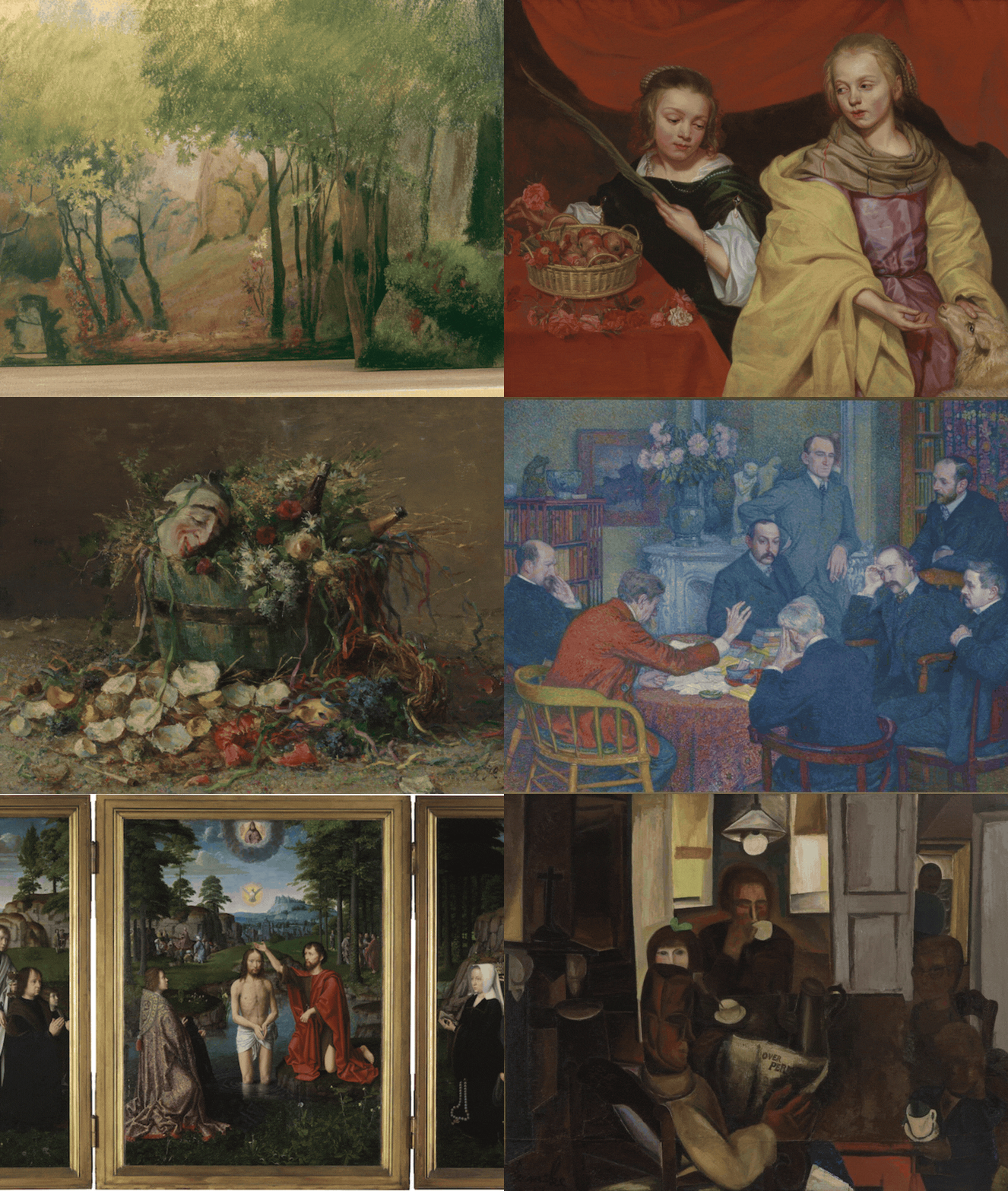
Sources used images: see below
Evaluation and refinement
Based on the results, project partners will fine-tune the system and build further on what works best. Ultimately, the system will be integrated within the European Collaborative Cloud for Cultural Heritage.
Additional support
We want these workflows to be actively used. And that’s why, together with partners, we will provide supportive tools. We are also creating a video to clearly explain copyright: how to choose the correct rights statement for your images.
Partners
This project is being carried out in collaboration with:
Leibniz Information Centre for Science and Technology (TIB) – project coordinator
DARIAH
Austrian Academy of Sciences
Institute of Czech Literature of the CAS
Institute of Literary Research of the Polish Academy of Sciences
Europeana
Institute of Bioorganic Chemistry of the Polish Academy Sciences
Jozef Stefan Institute
University of the Basque Country
Professional Wiki
KM-A Knowledge Management
University of Helsinki
Takin.solutions
AUSTRALO
For our own case study, we are working closely with:
Want to know more? Visit the project website or subscribe to the project newsletter.
De lezing door Emile Verhaeren, Théo Van Rysselberghe, Collectie MSK, foto door Rik Klein Gotink, publiek domein
- T • +32 9 298 05 01
- M • bart.magnus@meemoo.be
The views expressed on this page do not necessarily reflect those of the European Union. The EU and funders accept no responsibility.
Used images:
Parsifal - décormaquette door Jean Delescluze - 1914 - De Munt / La Monnaie - CC BY-ND
Michaelina Wautier, Twee meisjes als de heiligen Agnes en Dorothea, inv.nr. 599, foto: Rik Klein Gotink, Koninklijk Museum voor Schone Kunsten Antwerpen - Collectie Vlaamse Gemeenschap (public domain)
Daags na carnaval, Hubert Bellis, ca. 1850-ca. 1900, Collectie M Leuven, bron: artinflanders.be, foto: Dominique Provost
De lezing door Emile Verhaeren, Théo Van Rysselberghe, Collectie MSK, foto door Rik Klein Gotink, publiek domein
Gerard David, Doopsel van Christus, ca. 1502-1508, olieverf op paneel, Musea Brugge, inv. nr. 0000.GRO0035.I-0039.I, foto: Hugo Maertens
Over Permeke, door Constant Permeke, Collectie Mu.ZEE, foto door Cedric Verhelst, publiek domein